Target and Lowe's both reported third-quarter results this morning and both beat Wall Street's earnings estimates. Part of each beat came from the federal government. Target said tariff refunds added $0.50 to its earnings per share and Lowe's said they added $0.34. That money is a return of tariffs the companies paid in 2025 and early 2026. It won't repeat, so I take it out before I decide what a quarter says about the business.
Where the refunds come from
In February the Supreme Court ruled in Learning Resources v. Trump that the International Emergency Economic Powers Act does not give the president the power to impose tariffs (Cato has a good summary of the refund process since then). About $166 billion had been collected under those tariffs, according to CBP's reports to the trade court as summarized by Novus Data. Importers have been claiming refunds through CBP's CAPE system since April. As of November 5, CBP said about $128.4 billion, including interest, had been certified and sent to the Treasury for payment, according to GEODIS. That is roughly 77% of the amount collected.
The refunds started to show up in retail earnings in the summer quarter. Each company has handled them a little differently, which makes the headline numbers harder to compare.
| Company | Fiscal Q2 2026 | Fiscal Q3 2026 |
|---|---|---|
| Target | $1.65 per share ($994 million pretax) | $0.50 per share ($301 million pretax) |
| Lowe's | $0.11 per share (about $80 million) | $0.34 per share (about $250 million pretax) |
| Home Depot | $730 million received, about $685 million used to lower cost of goods sold | No refund benefit called out |
Sources: Q2 figures from CNBC. Q3 figures from the Target, Lowe's and Home Depot earnings releases and the Home Depot earnings call.
What the quarters look like without the refunds
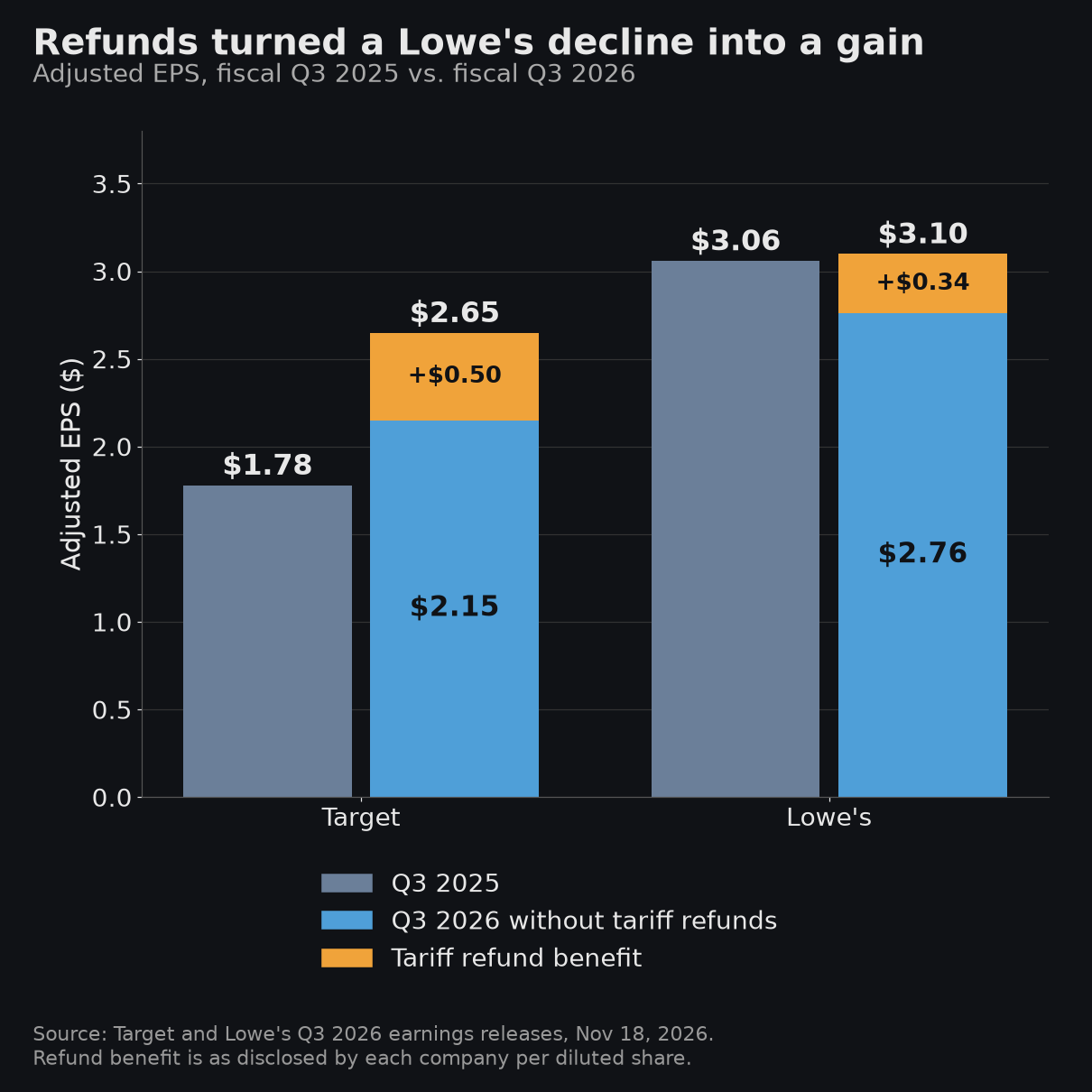
Target reported adjusted EPS of $2.65 compared with $1.78 a year ago. Without the refunds it would have been about $2.15, which Target itself puts at a 21% increase. Comparable sales grew 5.6% and comparable traffic grew 5.0%. Those are the best parts of the report for me because a refund can't produce more shoppers. My read of Target is that the business improved and the refund made the improvement look larger than it was. The stock was down about 1% in premarket trading, according to CNBC.
Lowe's is a different case. Adjusted EPS rose 1.3% to $3.10 from $3.06. Without the $0.34 refund benefit it would have been about $2.76, which is around 10% lower than a year ago. Total sales grew 9.3% while comparable sales grew 1.8%. The difference reflects the Foundation Building Materials and Artisan Design Group acquisitions, which aren't counted in comparable sales. Online sales grew 17.4% and Lowe's raised its full-year sales outlook to about $92.5 billion. It also lowered its operating margin outlook to about 11.1% from 11.2%, citing cost pressures. The shares fell more than 3% before the open, according to CNBC and its premarket movers coverage. I think the market did the same subtraction I did.
Home Depot reported on Tuesday and did not call out a refund benefit for the quarter. Its adjusted EPS rose 3.2% to $3.86 and its operating margin fell to 12.6% from 12.9%. That is a slower quarter than Target's but it's a cleaner number to read.
How I'm treating these numbers
For the rest of this earnings season I'm going to subtract refund benefits from every retailer I look at, including when a company leaves them in adjusted EPS. This matters most for valuation. A price-to-earnings ratio calculated on refund-boosted earnings makes a stock look cheaper than it is. Target's new full-year guidance of $10.65 to $11.40 per share includes about $2.14 of refunds recognized so far this year and excludes any future refunds. Without them, the range is about $8.51 to $9.26 and that is the number I would use.
The bigger issue comes next year. Most of the refund money has already been paid, so these benefits will shrink and then stop. In 2027 Target, Lowe's and others will be compared against quarters that included refunds. Target's second quarter of 2027 will be measured against a quarter with $1.65 per share of refunds in it. I expect headlines next summer saying retail earnings fell and I expect a large part of that decline to be the refunds rolling off. I plan to judge those quarters on the same ex-refund basis I'm using now.